
BEHIND THE GAME
Follow the development of Project Golf Board Game from an idea on paper to a finished tabletop golf game.
We'll share the decisions, prototypes, artwork, playtesting and occasional wrong turns that shape the game along the way.
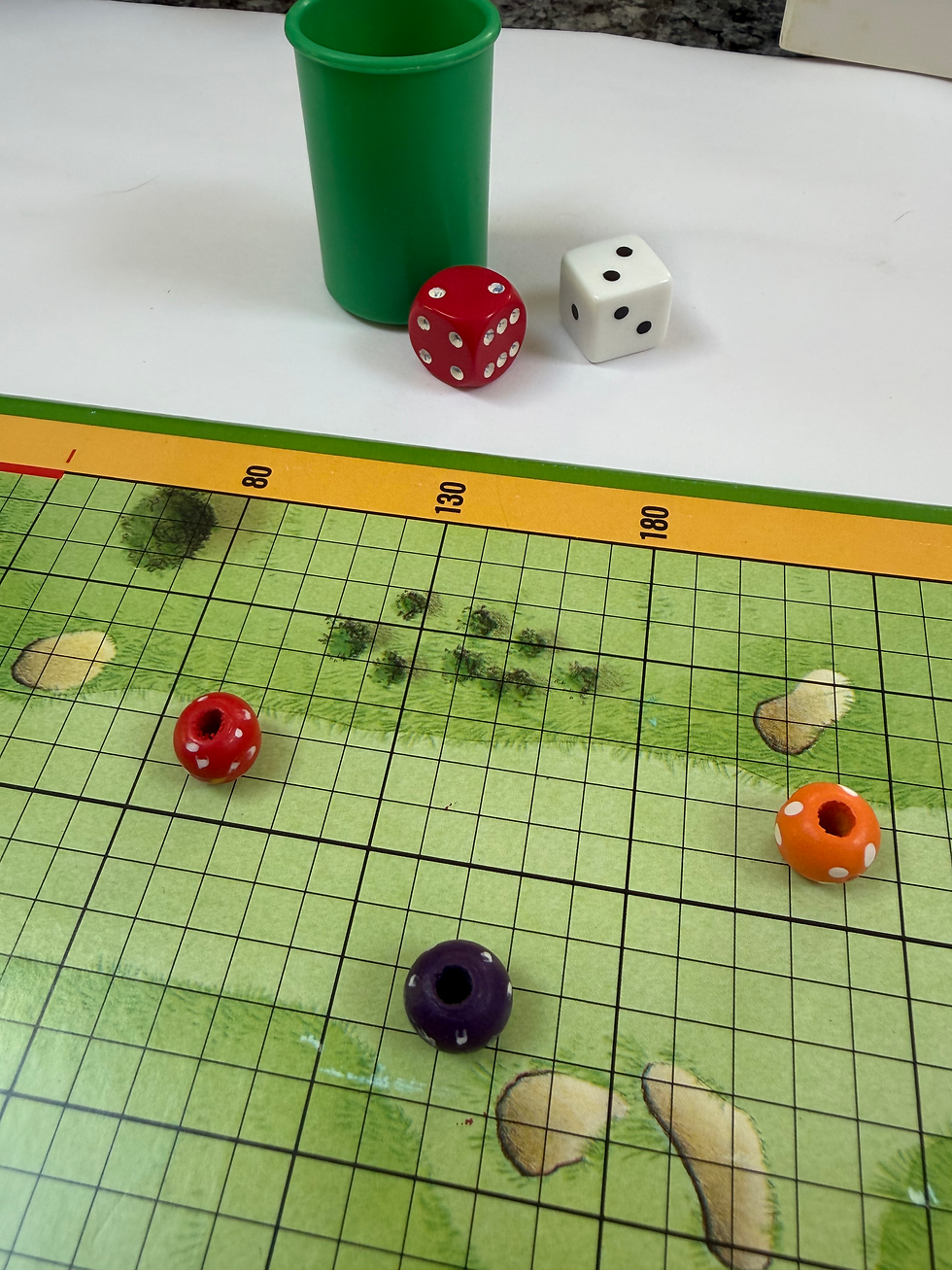
STARTING SIMPLE — MARCH 2026
The earliest versions of the game used ordinary six-sided dice. At this stage, they were simply a quick and familiar way of testing how dice could control a golf shot.
But as the game developed, it became clear that a D6 could not provide enough possible outcomes. With players making decisions about distance, direction and shot selection, we needed far more variation than six faces could offer.
The search for the right dice had begun.
MORE FACES, MORE POSSIBILITIES — APRIL/MAY 2026
As the game developed, sets of D12 and D20 dice were brought into testing. With many more possible results than the original D6s, they immediately felt better suited to the growing shot system.
The additional faces gave us much more scope to experiment with distance and direction, while still keeping the uncertainty of a dice roll at the heart of every shot.
At this point, we did not yet know which dice would survive into the final game — but we were getting closer.

BUILDING THE SHOT SYSTEM — SUMMER 2026

The next stage was to give every face of the dice a specific result.
A D12 controlled direction, while a D20 controlled distance. Rather than simply rolling high or low, each number corresponded to a predetermined outcome, allowing us to shape the probabilities behind every shot.
Different distance dice were then developed for different types of club — driving, long shots, mid-range shots, pitching and wedges — with each producing distances appropriate to that part of the real game.
This was an important step. The dice were no longer simply generating random numbers; they were beginning to recreate the unpredictability of actually hitting a golf shot.
FROM PAPER TO CUSTOM DICE — JULY/AUGUST 2026
The next step was to take the results we had been testing on paper and put them directly onto custom dice.
The first prototypes quickly exposed two problems. At only 20mm wide, the dice were simply too small, and we had tried to put far too much information onto each face. The arrows, distances and wording that worked on a design sheet became difficult to read on a physical die.
It was a useful failure. The dice needed to be bigger, clearer and simpler.
The current design has therefore moved towards 25mm D12 dice for both direction and distance, with much cleaner faces and the more detailed rules handled elsewhere.
The dice are still evolving — but every prototype is getting us closer.
